Imagine you’re in Tokyo, Japan and you’ve never been there before. Despite being a stranger in town, you checked into a hotel near a rail station to easily navigate around. The time passes quickly while you unpack your suitcase, and before you know it, it’s 7pm. Dinner time!
Instead of dining at a hotel, you go outside and search for affordable dining options. You’re not against dining at a fancy restaurant, but your goal is to save as much money as possible to spend on attractions.

Upon entering the 7-Eleven near your hotel, you are immediately greeted by rows and rows of display shelves. Since this is your first visit to Japan, you chose items that you could recognize right away: Grilled Salmon Onigiri and Iced Americano.
The price tags are easy to read, even if you’re a little confused about the actual price. Instead of waiting in line just to ask for the prices of the items, you decide to find it yourself. You open up your phone, fire up Google Lens, and scan the label. You are amazed watching it translate the words with remarkable precision. It turns out that in Japan, they display two different prices for the price tag: base price and price after tax.
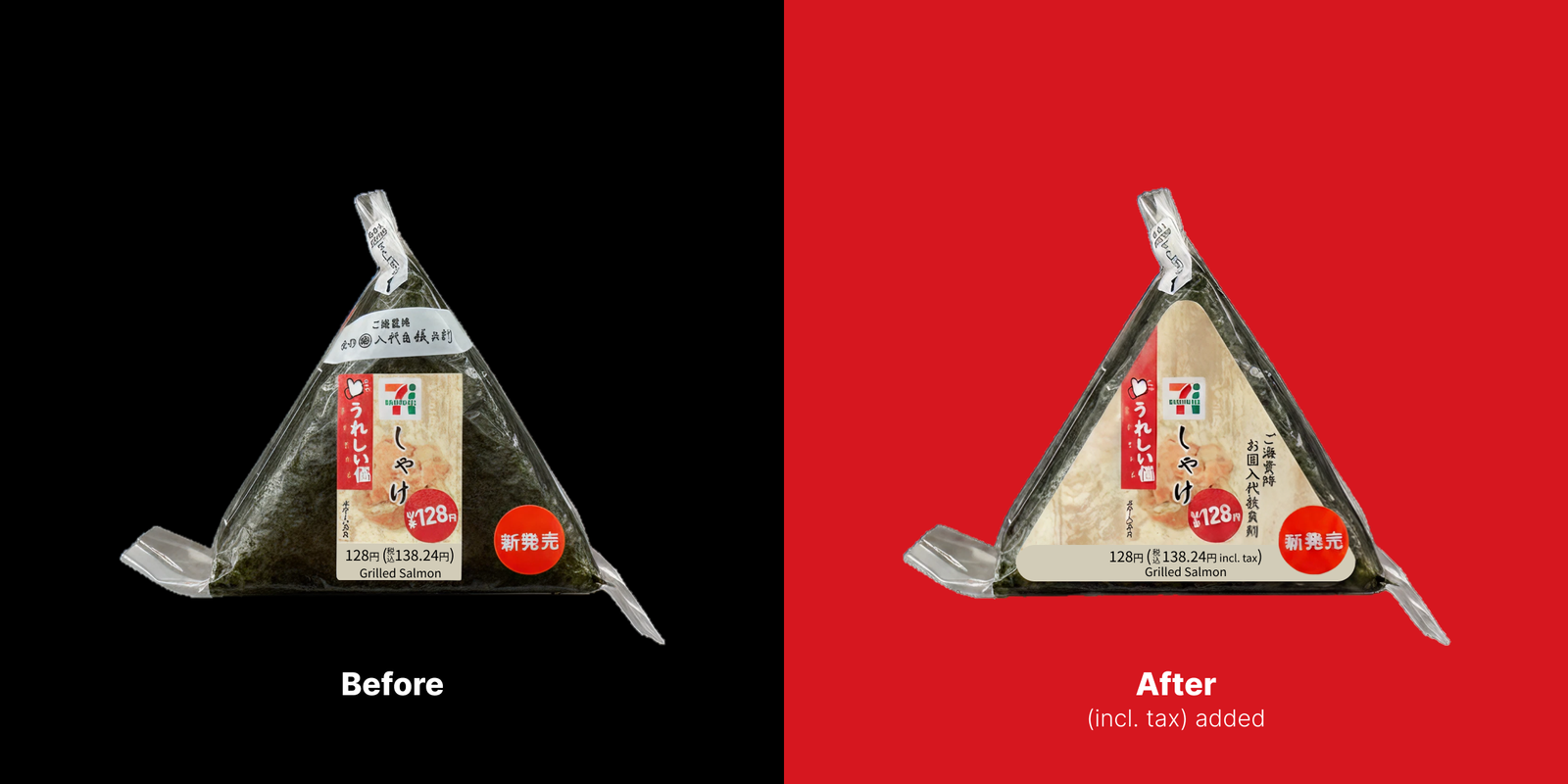
Therefore the actual cost of Grilled Salmon Onigiri that you hold in your hand is 138.24円 (including 8% tax) instead of 128円. And after paying for the meal and leaving the store, you feel proud that you have overcome the language barrier on your own. You smiled.
What’s the lesson learned here?
Tiny Changes, Remarkable Results
In our Onigiri case, the story will be quite different if you are without access to Google Lens, ChatGPT, or any other app that can help translate those Kanji words. You could have been perplexed, unsure of how much you should pay for the items instead of feeling elated and smiling. All because the price tag design lacks something that could make it self-explanatory.
If you’ve ever read Atomic Habits (I highly recommend it!), James Clear wrote about the difference a tiny improvement can make over time. He mentioned that a 1 percent improvement isn’t very noticeable – sometimes it’s not even noticeable – but it can be more meaningful, especially in the long run. The same rule for improving habits 1% at a time applies to design as well.
Given the problem we have, what is your take on it? What is the 1% adjustment to the price tag design that you think can make it easier to read for non-natives?
Here’s my take: Just add the word ’incl. Tax’.


Instead of writing it down as “128円 (税込138.24円”, we can change the wording a bit and write it down as “128円 (税込138.24円 incl. tax).”
Now I don’t have to read the language to be able to figure out how much I have to pay for it, since it is already there. The Grilled Salmon Onigiri price is 138.24円 including tax. Voila!
Your Takeaway
So what’s your takeaway on this? What will you do differently?
What is one small change that can make a day and night difference in your design for your users?
What is one small change that can make a day and night difference in your design for your users?